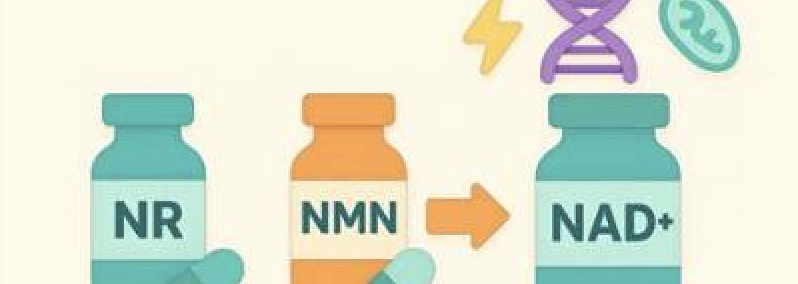
NMN (nicotinamide mononucleotide), NR (nicotinamide riboside), and resveratrol are among the most extensively studied molecules in the field of longevity. Their interest primarily lies in their potential ability to target biological mechanisms involved in cellular ageing.
A – Why are these molecules attracting so much interest?
Ageing is notably associated with:
– a decline in cellular NAD⁺ levels;
– reduced mitochondrial energy production;
– increased oxidative stress;
– chronic low-grade inflammation (“inflammaging”);
– a decline in DNA repair capacity.
NMN, NR, and resveratrol target several of these biological mechanisms.
1. NMN: A Direct Precursor of NAD⁺
NMN is converted into NAD⁺, a molecule that is essential for:
-ATP production;
– DNA repair;
– sirtuin activity;
– mitochondrial function.
In humans, clinical trials have primarily demonstrated:
– increased blood NAD⁺ levels;
– good tolerability;
– some improvements in metabolic or vascular parameters in certain populations.
However, no study to date has demonstrated that NMN extends human lifespan.
2. NR: Another NAD⁺ Precursor
NR follows a different metabolic pathway but ultimately leads to the same outcome: an increase in NAD⁺ levels. Clinical evidence is currently more extensive for NR than for NMN and indicates:
– a significant increase in NAD⁺ levels;
– an excellent safety profile;
– potential improvements in:
• blood pressure in certain individuals;
• arterial stiffness;
• certain inflammatory biomarkers.
The effects remain modest.
Aging is notably associated with:
– decreased NAD⁺ levels in cells;
– reduced mitochondrial energy production;
– increased oxidative stress;
– chronic low-grade inflammation (“inflammaging”);
– reduced DNA repair capacity.
NMN, NR and resveratrol target several of these mechanisms.

.
.

3. Resveratrol
Resveratrol may:
– indirectly activate SIRT1;
– reduce oxidative stress;
– reduce inflammation;
– improve endothelial function;
– protect mitochondrial function.
In humans, however, the results are less impressive than those observed in animal studies.
NMN/NR is often combined with resveratrol with the aim of complementing their respective biological mechanisms. Today, longevity experts generally recommend:
– NAD⁺ precursors (NR and NMN), which are considered among the most promising candidates in the nutraceutical field.
– resveratrol, which exhibits interesting biological effects, but whose clinical efficacy remains limited by its low bioavailability;
– maintaining high NAD⁺ levels.
B – Perspectives for Food Supplement Development & Regulatory Status
In the nutraceutical field, the most innovative formulations are no longer based solely on the NMN/NR + resveratrol combination. They often combine several complementary mechanisms, for example:
– Polyphenols: resveratrol, fisetin, quercetin;
– Mitochondrial health: Urolithin A, PQQ, coenzyme Q10;
– Cellular energy: creatine, alpha-lipoic acid;
– Neuroprotection: omega-3 DHA, citicoline;
– Inflammation and oxidative stress: curcumin, EGCG, astaxanthin.
These approaches aim to act simultaneously on several of the key biological mechanisms associated with ageing, in line with current developments in longevity research. However, the regulatory framework has not, to date, authorized all of these ingredients for use in food supplements.
In Europe (European Union), NMN (β-nicotinamide mononucleotide) is currently not authorized as an ingredient in food supplements. Its regulatory status is that of a non-authorized Novel Food.
NMN is considered a food that was not consumed to a significant degree in the European Union before 15 May 1997. As such, it falls within the scope of Regulation (EU) 2015/2283 on Novel Foods. This means that, in order to be legally marketed in the EU as a food supplement or food, NMN must:
– be the subject of an application for authorization as a Novel Food;
– be assessed by the European Food Safety Authority (EFSA);
– subsequently be authorized by the European Commission and included in the Union list of authorized Novel Foods.
To date, this authorization has not been granted. Therefore, in principle:
❌ NMN cannot be placed on the EU market as a food supplement;
❌ an EU-based manufacturer cannot legally use NMN in a formulation intended for the European market;
❌ national authorities may require products containing NMN to be withdrawn from the market.
In practice, some websites offer NMN to European consumers. However, the availability of such products online does not mean that they comply with EU food legislation.
It is important to distinguish NMN from NR (nicotinamide riboside). NR has been authorized ✅as a Novel Food, subject to specific conditions of use, in the European Union.
NR can therefore legally be used in several categories of food supplements, unlike NMN.
In Switzerland, the regulatory framework is not identical to that of the European Union.
Conclusion
The regulatory status of NMN continues to evolve. Several companies have submitted or are preparing Novel Food applications, and if EFSA concludes that NMN has a satisfactory safety profile, an authorization could potentially be granted in the coming years. However, as of today, no authorization decision has been published.
If your objective is to develop a longevity-focused food supplement intended for the European or Swiss market, regulatory expertise is essential from the earliest stages of formula development.
To read too:
- White label, a solution?
- Probiotics: What is this new trend consisting of bacteria for In & Out use?
- Cosmetic Packaging: Airless, bio-sourced & refillable for greener products
- Cosmetics: towards green formulation
- Powdered cosmetics, a trend to follow?
- Regulation and development of cosmetic ranges or well-being products
- https://www.instagram.com/mesactifsprecieuxbyncc/
Do you want to develop new products? Discover our free In&Out product catalogue!
